Dhowa Rock Temple: What Makes It Worth Visiting?
Ella is famous for mountain viewpoints, railway journeys and waterfalls, but there is another side to the area that is much quieter.
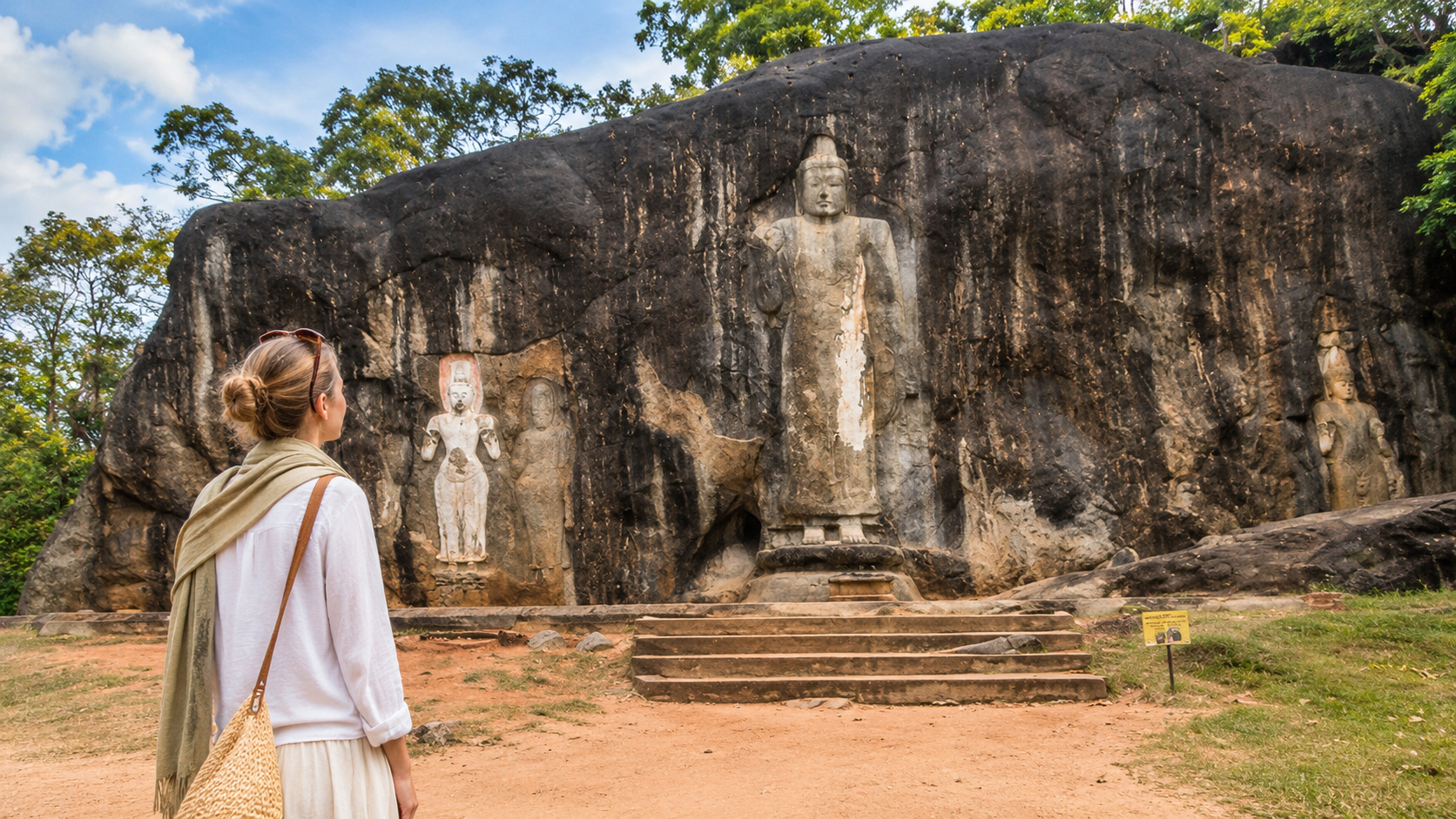
Dhowa Rock Temple is an ancient Buddhist temple located between Ella and Bandarawela in Sri Lanka’s Uva Province. Hidden below the main road among trees and rocky surroundings, the temple is best known for an enormous unfinished Buddha image carved directly into a granite rock face.
Where Is Dhowa Rock Temple?
Dhowa Rock Temple, also known as Dhowa Raja Maha Viharaya, stands in Dhowa village along the Bandarawela–Badulla road.
It is only a short journey from Ella and Bandarawela, making it an easy cultural stop for travellers exploring Sri Lanka’s hill country.
From the roadside, the scale of the temple is not immediately obvious. Steps lead down through the greenery towards the temple buildings, cave shrine and rock-carved Buddha.
How Old Is Dhowa Rock Temple?
The origins of Dhowa Rock Temple are traditionally associated with King Vattagamani Abhaya, better known as King Valagamba, who ruled during the 1st century BCE.
According to tradition, the king sought refuge in caves in different parts of Sri Lanka while temporarily driven from his kingdom by South Indian invaders. Dhowa is believed to have been one of the places connected with this period.
Like many historic Buddhist sites in Sri Lanka, Dhowa developed over different periods. The paintings visible inside the shrine show strong artistic influence from the much later Kandyan era.
The Unfinished Buddha Is the Main Attraction
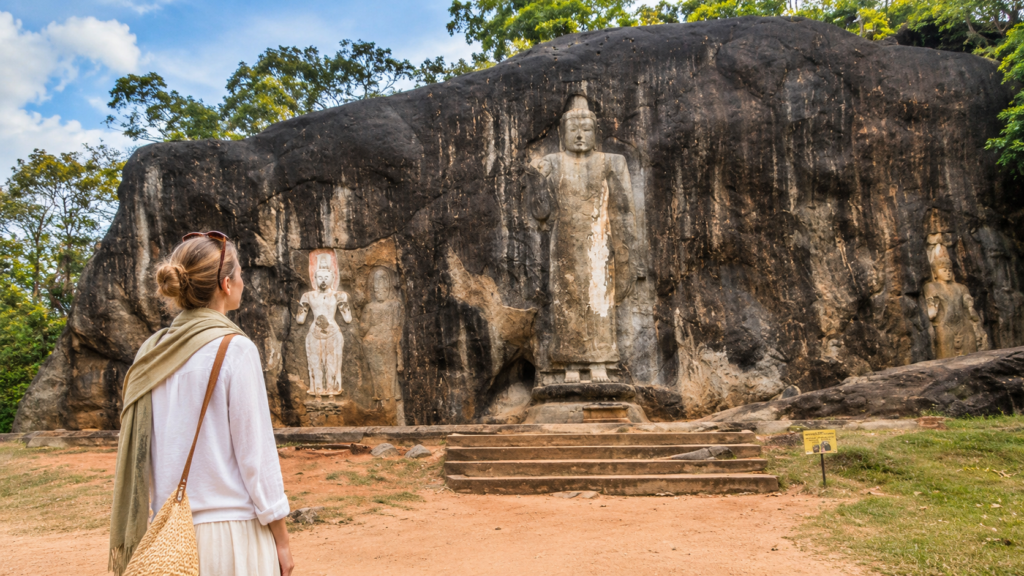
The feature that immediately separates Dhowa Rock Temple from many other temples around Ella is its enormous standing Buddha.
The figure is approximately 12 metres, or 38–39 feet, high and was carved directly into the granite rock face.
Unlike a freestanding statue placed in front of the rock, the Buddha emerges from the natural stone itself.
Most strikingly, the sculpture was never fully completed.
Exactly why the statue was left unfinished is uncertain.
Local tradition connects it with King Valagamba and says work stopped when the king left the area. This is an important part of Dhowa’s folklore, but it should be understood as a traditional story rather than established historical fact.
Step Inside the Cave Shrine
The rock-carved Buddha may attract the most attention, but the interior of Dhowa Rock Temple is equally worth seeing.
The shrine extends into the natural rock and contains Buddha images surrounded by colourful paintings.
Many of the murals show characteristics associated with Kandyan-period Buddhist art. They include scenes from Jataka stories, which recount the Buddha’s previous lives.
Floral patterns also cover sections of the cave ceiling, including lotus designs and other decorative motifs.
One particularly noted image is the Ath-Gon Satana, depicting a confrontation between an elephant and a bull.
What About the Secret Tunnel?
One of the most intriguing stories connected with Dhowa concerns a passage inside the temple.
A tunnel entrance can be found near the rear section of the cave shrine, although visitors cannot explore it.
Local stories claim that underground passages once connected Dhowa with other religious sites in the region. Different versions of the story give different destinations and distances.
It is therefore better understood as part of the folklore surrounding Dhowa Rock Temple rather than as a proven ancient transport route.
Why Visit Dhowa From Ella?
Travellers who have already explored the railway landscape around the Demodara Loop can visit Dhowa to experience the region’s Buddhist heritage instead.
The temple is also considerably smaller than famous complexes such as Dambulla, making it possible to appreciate the setting without turning the visit into a major day trip.
For travellers interested in Sri Lanka’s cave temples, the Dambulla Cave Temple offers an interesting comparison. Dambulla is far larger and contains five major cave shrines, while Dhowa feels more intimate and is distinguished by its unfinished outdoor rock carving.
Remember That It Is an Active Temple
Dhowa Rock Temple remains a Buddhist place of worship, not simply a historical attraction.
Visitors should wear clothing that covers the shoulders and knees and remove footwear and hats where required before entering sacred areas.
Photography should also be approached respectfully, particularly inside shrine spaces or when worshippers are present.
Conclusion
Dhowa Rock Temple is worth visiting because it reveals a side of Ella that can easily be missed among its famous hikes, bridges and viewpoints.
For travellers interested in history and culture, Dhowa provides a quiet and fascinating contrast to Ella’s better-known outdoor attractions.